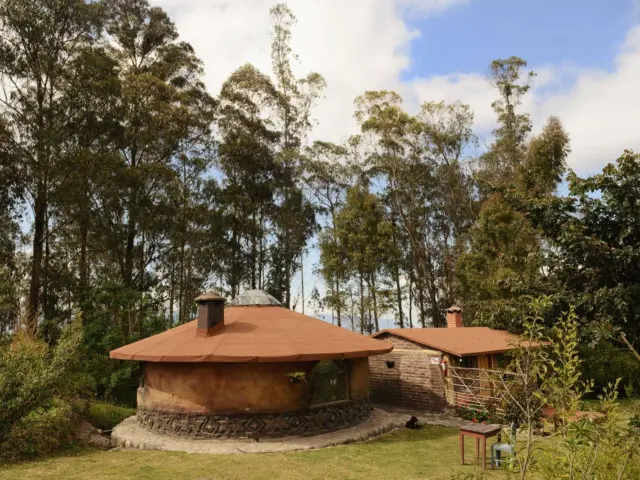
Wondering whether a wall of packed tires can really keep a home comfortable? Earthship thermal mass works by soaking up sun-heat by day and releasing it at night, which smooths out temperature swings, though results depend on climate and design.
| Item | Value |
|---|---|
| Design comfort target described for Earthships | Close to 70 °F (21 °C) |
| First Earthship in the UK (Fife, Scotland) | 2004 |
| Brighton Earthship established | 2005 |
| Brighton feasibility study length | Six months |
These figures come from Wikipedia’s Earthship entry and Interesting Engineering. The figures can change, so check the sources before you rely on them.
What thermal mass actually does
Thermal mass is heavy material that stores heat and gives it back slowly. According to the NJ Green Building Manual, thermal massing uses building materials to absorb, store and release heat produced by sunlight.
In practice that means a dense wall behaves like a slow battery. It does not make heat; it shifts heat from the hours when you have too much to the hours when you have too little.
- In winter, the mass takes in sunlight during the day and lets it out through the night.
- In summer, it absorbs warmth from the air and helps cool the building.
- Dense, heavy materials such as concrete, stone, brick and tile are the usual choices, alongside water.
The Rutgers manual also notes that passive solar design uses thermal mass as part of an overall strategy for comfort without mechanical heating and cooling. Mass alone is never the whole plan.
How an Earthship builds its thermal mass
Earthships are described as passive solar earth shelters made of natural and upcycled materials, including earth-packed tires. The tires are filled by hand with soil, and the result is a very dense, very thick wall. The method is covered step by step in the guide to rammed earth tire wall construction.
The layout matters as much as the walls. Interesting Engineering describes the concept as large, south-facing windows, angled to collect sunlight and heat, with a thermal mass at the rear made from used car tires and pounded earth.
Put simply, the glass is the collector and the earth-packed wall is the store. If you are new to the overall idea, start with what is an earthship, then come back here for the heat side of the story.

The 70 °F (21 °C) claim, and how to read it
Wikipedia says Earthships are designed to withstand desert extremes, managing to stay close to 70 °F (21 °C) regardless of outside weather conditions. It also says they rely on thermal mass construction and natural cross-ventilation to regulate indoor temperature.
Read that as a design intent rather than a guarantee. The same page says these buildings do not use electricity or fuel to maintain temperature, which is the ambition, not a measured result for every site.
Why climate changes the answer
Mass only helps if there is a swing to even out. A site with warm days and cool nights lets the wall charge and discharge every single day. A site that stays cold or humid for weeks gives the wall little to work with.
That matters for anyone thinking about Japan, where climates range from snowy northern winters to hot, humid summers. A few questions are worth asking about any site:
- Does winter sun reach the glass on clear days, or is the site shaded by hills or trees?
- Are there long overcast spells when the wall cannot recharge?
- In humid summers, can the building be ventilated at night to shed stored heat?
Passive solar guidance also lists several ways to collect heat. Direct gain uses south-facing windows and masonry floors and walls, while indirect gain places mass between the glass and the living space, as a Trombe wall does. An Earthship leans mostly on direct gain.
Limits and honest cautions
Thermal mass is often described as a cure-all in Earthship marketing, but it is a physical effect with clear boundaries. Knowing those boundaries helps you judge any plan or any owner story you read.
A heavy wall is slow. It can take a long time to warm up after a cold spell.
Good thermal mass also needs good insulation around it. Heat stored in a wall is only useful if it is not lost straight to the outdoors, so the outer side of the mass and the roof still have to do their share.
- Mass smooths temperature but does not replace a heat source in very cold or very cloudy climates.
- Glass that faces the wrong way, or is unshaded in summer, can overheat the space.
- Moisture and poor ventilation are separate problems that mass does not solve.
The wider guide to earthship building places these cautions alongside the rest of the build decisions, from site choice to materials. Weigh thermal behaviour early, because glazing angle, wall thickness and roof design are hard to change once construction has started.
Practical points before you rely on mass
Treat the wall as one part of a system that includes glazing, ventilation, shading and insulation. If any part is weak, the others cannot fully make up for it.
- Check how much winter sun actually reaches the glass on your site.
- Decide where the mass sits, so the sunlight lands on it directly.
- Plan shading so summer sun stays off the mass and the glass.
- Provide vents that open at night to release stored heat.
- Keep a modest backup heat source in mind for the coldest, cloudiest spells.
Owners and builders who plan this way tend to understand what the walls can and cannot do, and that keeps expectations realistic.
A short history of testing the idea
The first Earthship in the UK was built in 2004 at Kinghorn Loch in Fife, Scotland, with the Brighton Earthship established the following year. Interesting Engineering reports that the Brighton project was preceded by a six-month feasibility study funded by the UK Environment Agency and the Energy Savings Trust.
Projects like these exist partly to evaluate the concept in a cool, damp climate rather than the desert it was first designed for. That makes them useful reference points if your own climate is closer to Britain than to New Mexico.
Frequently asked questions
Does thermal mass heat a house by itself?
Show answer
No. It stores heat that came from somewhere else, mainly sunlight through the windows. Without a source of heat the mass simply settles to the surrounding temperature.
Do tire walls work better than other masonry?
Show answer
No independent source cited here proves this. The Rutgers manual lists concrete, stone, brick and tile as common thermal mass, so the tire wall is one dense option among several rather than a proven winner.
Will an Earthship stay at 70 °F (21 °C) all year?
Show answer
That is the design target described on Wikipedia, not a guarantee. Real results depend on climate, orientation and insulation.
Is thermal mass useful in a humid climate?
Show answer
Thermal mass can absorb warmth from the air and help cool a building in summer, but the supplied evidence does not establish its effectiveness in humid climates.